Beyond One Exam: Why Youths Support Further Reducing PSLE’s Weight in Secondary School Posting
Pulse of Tomorrow’s Junior Council carried a motion calling for further reductions in the PSLE’s weight in secondary school posting, reflecting youth concerns about high-stakes pressure. The position aligns with MOE’s stated intent to study how exam stakes can be reduced further through broad public engagement.
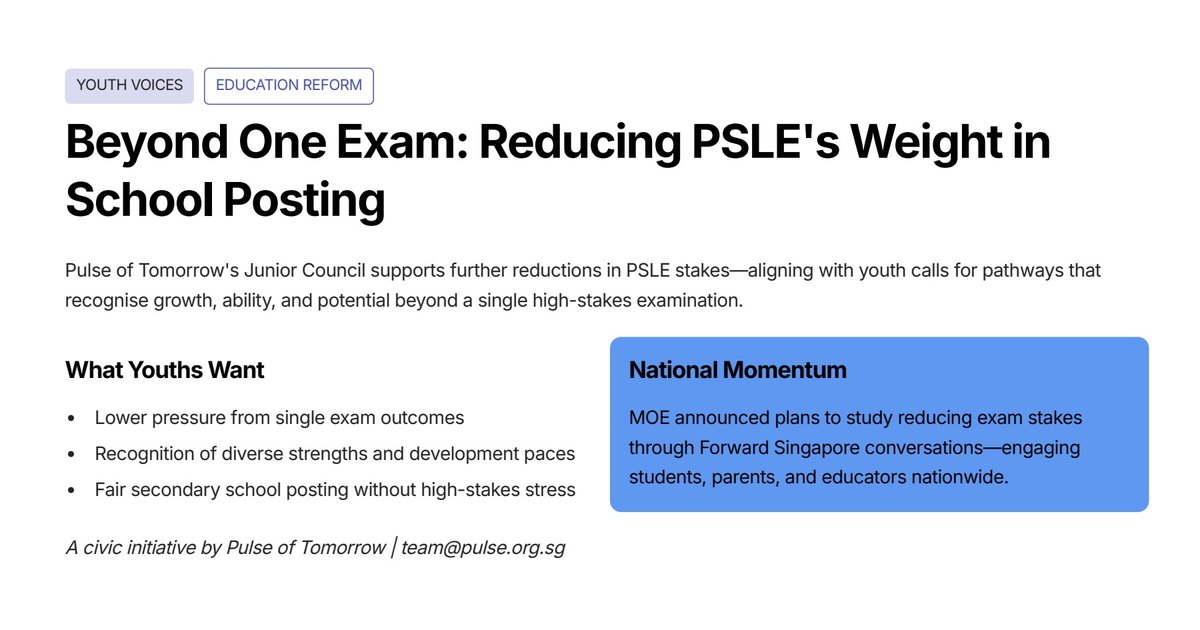
Pulse of Tomorrow’s Junior Council carried a motion on 26 January, moved by its Chairman, Braven Ang, supporting further reductions in the weight of the PSLE when determining secondary school posting. The outcome is clear: youths want an education pathway that recognises ability and growth beyond a single high-stakes paper.
Why this matters for youths in Singapore
For many students, the PSLE can feel like a one-shot verdict that shapes school options, peer groups, and confidence at a formative age. When one exam carries outsized consequences, pressure rises for families and students, and learning can become narrowly focused on scoring rather than building curiosity, resilience, and strengths across different domains.
The broader issue: an “arms race” mindset
National conversations have long acknowledged that education can still feel like an arms race. Parents may wish to reduce “endless tuition” but fear their child will lose out if others continue. High stakes intensify competition, widen perceived gaps between students, and place sustained stress on households trying to keep up.
A timely national signal from MOE
As luck would have it, just three days later on 29 January, these concerns surfaced prominently at the national level. In an interview reported by Channel NewsAsia, Desmond Lee, Minister for Education, said the Ministry of Education will study how to further reduce the stakes of examinations — including looking at exam difficulty and how results are used — and emphasised that MOE is not locked into any outcome. MOE also plans to engage students, parents, teachers, and academics through a series of education conversations under Forward Singapore.
While Pulse of Tomorrow did not submit this motion to MOE, the alignment in timing underscores how youth sentiments on the ground mirror broader national reflections on assessment, fairness, and well-being.
What could change for students and families
If exam outcomes are used in a less high-stakes way, incentives can shift towards steady learning, confidence-building, and long-term development. It also creates space for students who grow at different paces to find a right-fit environment, without being defined by one sitting. The goal is not to lower standards, but to avoid turning a single assessment into a proxy for a student’s full potential.
How the Junior Council is acting
Under the leadership of its Chairman and Council members, Pulse of Tomorrow’s Junior Council is translating lived student experience into constructive civic signals. We will gather youth perspectives on what “lower stakes” should look like in practice — including how to keep secondary school posting fair while supporting diverse strengths — and contribute these views through public engagement channels where appropriate, so that youth voices remain part of Singapore’s education conversations.
If you care about a school system that supports both achievement and well-being, join Pulse of Tomorrow — a youth-led civic platform where young Singaporeans turn everyday experiences into practical proposals for the community.
For media queries, contact [email protected] or call +65 6042 5410.