Designing for Coexistence: Youth Voices on Public Space, Affirmed
On 27 January, Pulse of Tomorrow’s Junior Council supported designated, dance-friendly public spaces. Days later, CNA’s national reporting echoed the same principles, affirming a youth-led call for trust, coexistence, and intentional public space design.
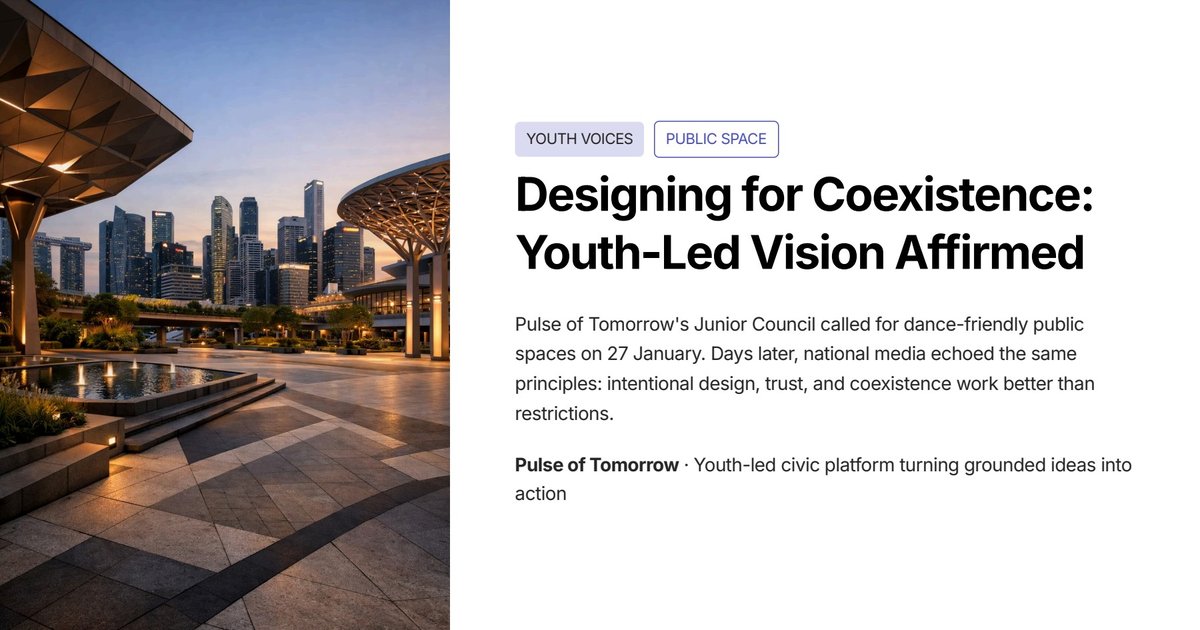
Pulse of Tomorrow’s Junior Council supported the provision of designated, dance-friendly public spaces in Singapore on 27 January. The position was grounded in a simple idea: when young people have safe, suitable places to practise, create, and connect, communities benefit and conflict is reduced.
Just days later, on 31 January, national discussion validated this approach. CNA’s Big Read on public space design examined how shared spaces in Singapore are shaped by design choices, norms, and trust, and how clampdowns without consultation often crowd out informal community life. The themes raised mirrored what youths had already articulated: public spaces work best when they are intentionally designed for coexistence rather than treated as problems to be managed.
Why this matters for youths in Singapore
For many youths, dance is more than a hobby. It is a way to manage stress, build confidence, and form social connections across schools, neighbourhoods, and backgrounds. Yet practising in spaces not designed for movement can create safety risks, disrupt pedestrian flow, and trigger conflict with other users.
In a dense city, these tensions are inevitable. What matters is how they are addressed. Blanket restrictions or hostile design often displace activities rather than resolve underlying needs.
Public space is cultural, not just physical
CNA’s reporting reinforces an important reality: public space is not neutral. Design choices, signage, and enforcement subtly signal who belongs, what is acceptable, and whose activities are prioritised.
When informal youth activities such as dance are quietly edged out, what is lost is not only the activity itself, but everyday social infrastructure that supports belonging, identity, and low-barrier connection.
What “dance-friendly” can look like
Designated does not mean exclusive. It means intentional and considerate. Dance-friendly public spaces can include:
- Safer surfaces that reduce injury risk
- Clear guidance on shared use and timings
- Adequate lighting and basic amenities
- Locations that are accessible and spread across neighbourhoods
These features allow different users to coexist while reducing friction and safety concerns.
A youth-led position, affirmed
The Junior Council’s stance was never about entitlement. It was about designing for coexistence through clarity, trust, and thoughtful planning.
That this perspective was echoed days later in national commentary matters. It shows that youth ground realities are not fringe views. When articulated constructively, they anticipate where public discourse and policy thinking are heading.
Pulse of Tomorrow will continue to engage youths and communities to ensure public spaces remain inclusive, humane, and reflective of everyday life.
If you care about youth well-being, inclusive communities, and building a Singapore where young people can thrive, join Pulse of Tomorrow, a youth-led civic platform that turns grounded ideas into action. For media queries, contact [email protected] or call +65 6042 5410.