Meaningful human oversight for AI in education
Pulse of Tomorrow's Junior Council carried a motion by Seah Xin An affirming that AI in education should remain under meaningful human oversight, especially in matters involving student well-being, discipline, and high-stakes decisions. The motion highlights why Singapore youths need trusted safeguards as AI becomes more common in schools.
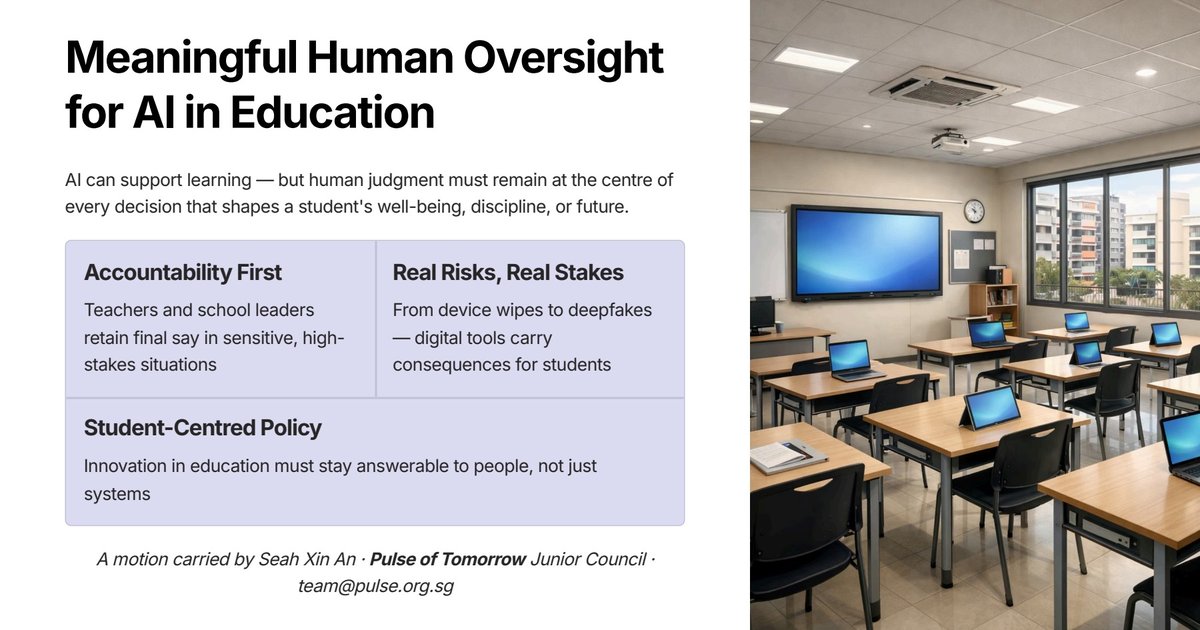
Meaningful human oversight for AI in education
Pulse of Tomorrow's Junior Council has carried a motion by Seah Xin An affirming that artificial intelligence used in education should remain under meaningful human oversight, especially where students' well-being, discipline, or high-stakes decisions are involved. The outcome is clear. AI can support learning, but it should not replace human judgment when the stakes are high for students.
This matters for youths in Singapore because AI is moving from theory into everyday school life. The Ministry of Education has said generative AI tools will be progressively introduced to students through the Singapore Student Learning Space in age-appropriate ways, while educators continue to study the impact on learning and over-reliance. As more students encounter AI in lessons, feedback, and support tools, the question is no longer whether AI will be present, but how it will be used responsibly.
Human oversight matters most when decisions affect a young person's trust, safety, and future. A student facing a discipline issue, mental health concern, or important academic decision should not be left at the mercy of an automated system that may miss context, misread tone, or produce inaccurate outputs. Even well-designed tools can make mistakes. In education, those mistakes can carry emotional and practical consequences for students and families.
Recent incidents in Singapore show why safeguards are necessary. In 2024, a cybersecurity incident involving Mobile Guardian affected about 13,000 students across 26 secondary schools when devices were remotely wiped, disrupting access to school materials. Separately, local reporting on AI-generated deepfake cases involving students has highlighted how new technologies can be misused in ways that harm dignity, privacy, and psychological safety. For youths, these are not abstract risks. They affect learning, reputation, and well-being.
The wider policy direction in Singapore also points toward responsibility, not blind adoption. Singapore's Model AI Governance Framework and the updated National AI Strategy both stress trusted, accountable AI. In schools, that principle should mean adults remain answerable for decisions, especially where student welfare is concerned. Teachers and school leaders should be supported to use AI as a tool, while retaining the final say in sensitive or high-impact situations.
Pulse of Tomorrow's Junior Council is acting by putting this principle on record and pushing for a student-centred approach to education technology. That means backing innovation that helps youths learn better, while insisting on clear limits, accountability, and human responsibility. It also means creating space for young Singaporeans to discuss how technology shapes fairness, safety, and trust in their daily lives.
If you are a young person who wants to engage real issues, shape constructive ideas, and be part of thoughtful civic conversations, join Pulse of Tomorrow, a youth-led civic platform. For media queries, contact [email protected] or call +65 6042 5410.