Put support first: Why schools should assess mental health before punishing non-violent misconduct
Pulse of Tomorrow's Junior Council carried a motion by Ang Kai Xuan Braven urging schools to prioritise mental health assessment before punitive discipline for non-violent misconduct. The aim is earlier support, safer help-seeking, and more effective interventions for students.
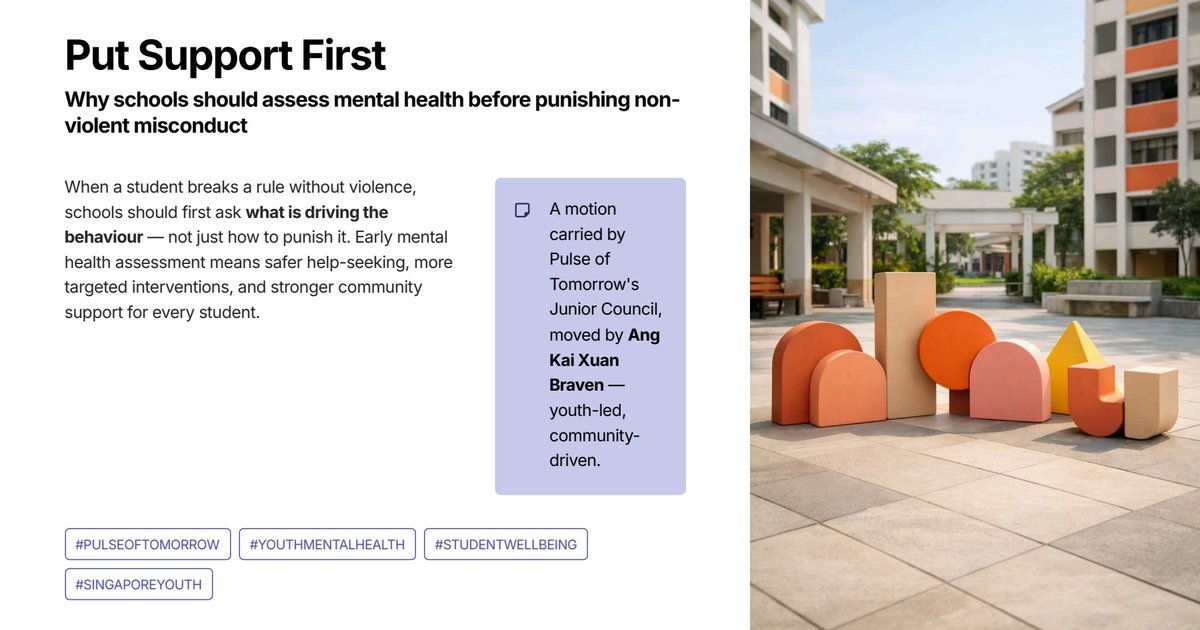
Pulse of Tomorrow's Junior Council carried a motion moved by Ang Kai Xuan Braven calling for schools to prioritise mental health assessments over punitive discipline when handling non-violent misconduct. The outcome is a clear youth stance: when a student breaks a rule without violence, schools should first ask what is driving the behaviour, not just how to punish it.
Why this matters for youths in Singapore
For many students, school discipline is not only about rules. It can also be a turning point that shapes whether they feel safe enough to seek help. IMH and NCSS have highlighted that young people face mental health concerns such as anxiety and depression, and early identification and support matter. When stress, family pressures, or undiagnosed difficulties show up as persistent lateness, skipping class, or disruptive behaviour, a purely punitive response can miss the root cause and worsen disengagement.
What “assessment” means in a school context
This is not about labelling students or replacing consequences with excuses. It means staff use informed judgement to check for warning signs, talk to the student, and decide whether referral to school counselling or community support is needed before escalating to punishment. MOE has stated that schools put in place student well-being supports, including counsellors and programs that build social and emotional competencies. This motion reinforces that these supports should be activated early, especially when the misconduct is non-violent.
Key implications for students, teachers, and families
- Safer help-seeking culture: Students are more likely to speak up when the first response is care, not fear.
- More targeted interventions: Schools can distinguish between deliberate misbehaviour and distress-driven behaviour, and respond accordingly.
- Stronger family and community support: When schools identify needs earlier, families can be connected to appropriate services sooner.
The bigger community impact
Youth mental health affects attendance, learning, relationships, and long-term outcomes. A system that defaults to punishment risks pushing students further away from school and support networks. A system that prioritises early assessment and referral can reduce escalation and strengthen trust between students and educators.
How Junior Council is acting
Pulse of Tomorrow's Junior Council will translate this motion into practical youth-facing work. We will develop a student-friendly explainer on what to expect when a school raises concerns about well-being, and what support pathways exist. We will also engage youths to gather ground realities on how discipline is experienced, and share insights with community partners to encourage responses that are firm, fair, and supportive.
If you are a young person who cares about mental health, school culture, and building practical solutions, join Pulse of Tomorrow, a youth-led civic platform where youths deliberate, propose, and act on community issues. For media queries, contact [email protected] or call +65 6042 5410.