Youth Voices on School Meals: Why Transparency and Trust Matter
Youth feedback on school meals was affirmed. MOE clarified central kitchens won’t replace all canteens, reinforcing the need for transparent, ongoing quality checks.
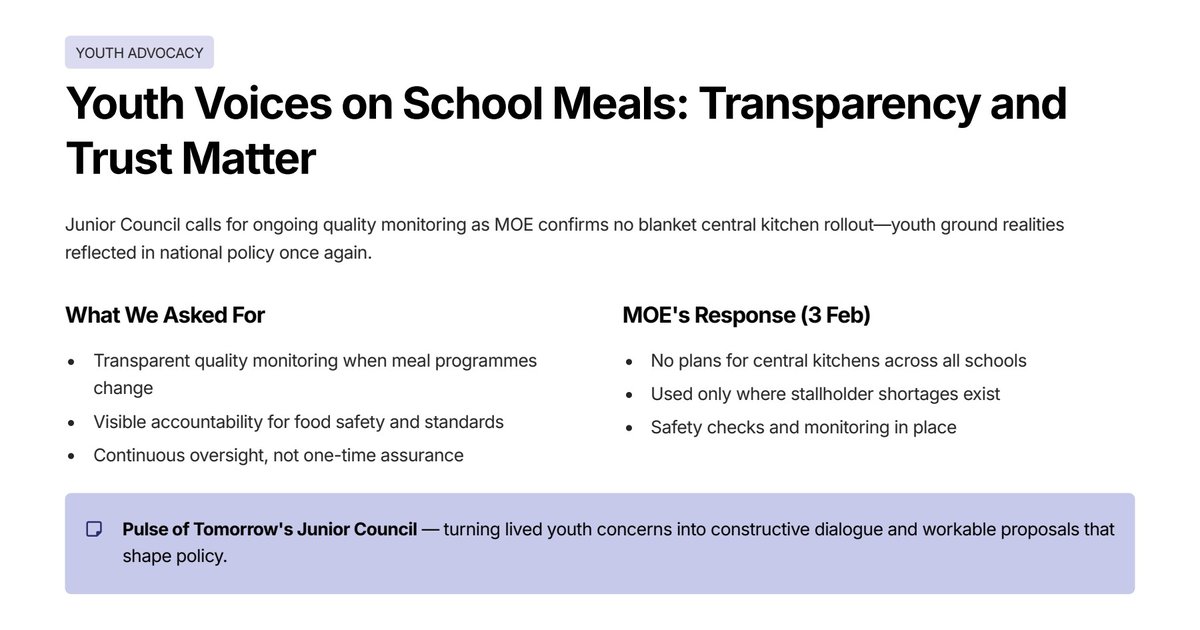
Pulse of Tomorrow’s Junior Council carried a motion moved by Ryan Wang calling on schools to avoid replacing traditional canteen vendors with pre-prepared meal programmes unless there is transparent, ongoing quality monitoring. The principle is straightforward: if a school changes how students are fed, accountability must be continuous, visible, and trusted by students and parents.
This position was taken earlier by the Junior Council. On 3 February, MOE clarified that there are no plans to introduce a central kitchen model across all schools, and that such arrangements are being used only where schools face difficulties securing stallholders. The ministry also emphasised inspections, food safety oversight, and monitoring. This alignment matters.
Why this matters to youths in Singapore
For many students, school meals are not occasional. They are daily fuel for learning, CCAs, and long school days. When food quality or safety slips, the impact is immediate. Lessons are disrupted, families worry, and health risks arise.
With centralised preparation, problems can scale quickly. A single lapse may affect many students at once. That is why youths are especially sensitive to how quality and safety are monitored when food is prepared off-site.
The underlying issue
Singapore has strong food safety standards, and the Singapore Food Agency sets clear hygiene requirements. However, when meals are prepared away from school, students and parents have less visibility over what happens between cooking, packing, transport, storage, and reheating.
The Junior Council’s position is not opposition to alternative models. It is a call for transparency. If schools adopt pre-prepared meal programmes, monitoring must be ongoing and clearly communicated, not assumed or treated as a one-time assurance.
Accountability should be visible, not assumed
Traditional canteen vendors are embedded in the school environment. When food is prepared on-site, feedback loops tend to be faster and accountability more direct.
A central kitchen model can still work where necessary, but trust must be built intentionally. Youths deserve clarity on what is checked, how often checks happen, and what actions are taken when standards fall short.
A youth-centric approach to quality monitoring
Monitoring should protect students without adding unnecessary bureaucracy. Practical signals of accountability could include:
- Clear hygiene and safety checks aligned with national requirements
- Regular, plain-language updates on basic audit outcomes
- Transparent escalation steps when complaints or incidents occur
- Ongoing review of taste, nutrition, and portion suitability for students
These measures help students and parents understand that quality is actively watched, not taken for granted.
Community impact
School meals sit at the intersection of health, affordability, and daily routine. When trust in school food drops, students may skip meals or rely on snacks instead. Over time, this affects well-being, concentration, and learning.
Keeping school food accountable is also about respecting families who depend on school meals to support long school days.
Youth voices, reflected again
The recent clarification by MOE reinforces what youths had already called for: careful use of alternative food models, strong oversight, and no blanket replacement of traditional canteens without safeguards.
This is another example of youth ground realities being reflected in national decision-making when they are articulated clearly and constructively.
If you care about practical issues that shape everyday youth life, join Pulse of Tomorrow. We are a youth-led civic platform that turns lived concerns into constructive dialogue and workable proposals.
For media queries, contact [email protected] or call +65 6042 5410.